Helping patients live beyond their condition.
Home pneumatic compression therapy for patients with lymphedema and chronic venous disease — coordinated from referral through home setup and ongoing support.

Your provider referred you to Waypoint
What compression therapy is, what happens next, and what we will need from you.
A simpler referral process for your office
Send the referral and available records. Waypoint reviews the case and tells your office what is still needed.
Chronic swelling is a disease, not a cosmetic problem.
Lymphedema and chronic venous disease do not resolve on their own. When swelling is not controlled, the consequences compound — and they show up in a patient's skin, their mobility and their independence.
- Recurrent infectionPoorly controlled swelling is associated with recurrent cellulitis and other skin infections.
- Skin breakdown and woundsHyperkeratosis, fibrosis, lymphorrhea and ulceration — and wounds that are harder to heal while edema is uncontrolled.
- HospitalizationInfection and wound complications are among the reasons these patients end up admitted.
- Lost mobilityHeaviness, tightness and increased limb girth limit walking distance, range of motion and daily activity.
- Lost independenceA patient who cannot get into normal shoes, or cannot manage their own garments, loses ground at home.
New cellulitis episodes among patients with prior episodes, across 52 weeks of at-home advanced pneumatic compression. Mean limb girth decreased and disease-specific quality-of-life measures improved.
Longitudinal observational study, 2024 — observational design, not a randomized trial. View studySaid plainly
Better edema control is intended to reduce complications and preserve function. It is not a guarantee, and serious progression is not inevitable. The point of getting a patient onto effective therapy is to stay ahead of these problems rather than manage them after they start recurring.
Therapy, education, and support that continues after the delivery.
The device is one part of it. What changes a patient's experience is whether they understand the therapy, use it correctly, and have someone to call.
Effective home therapy
Sequential pneumatic compression prescribed by the patient's physician, with the device and garment configured for the affected limb and the treatment plan that physician sets.
Education that holds up at home
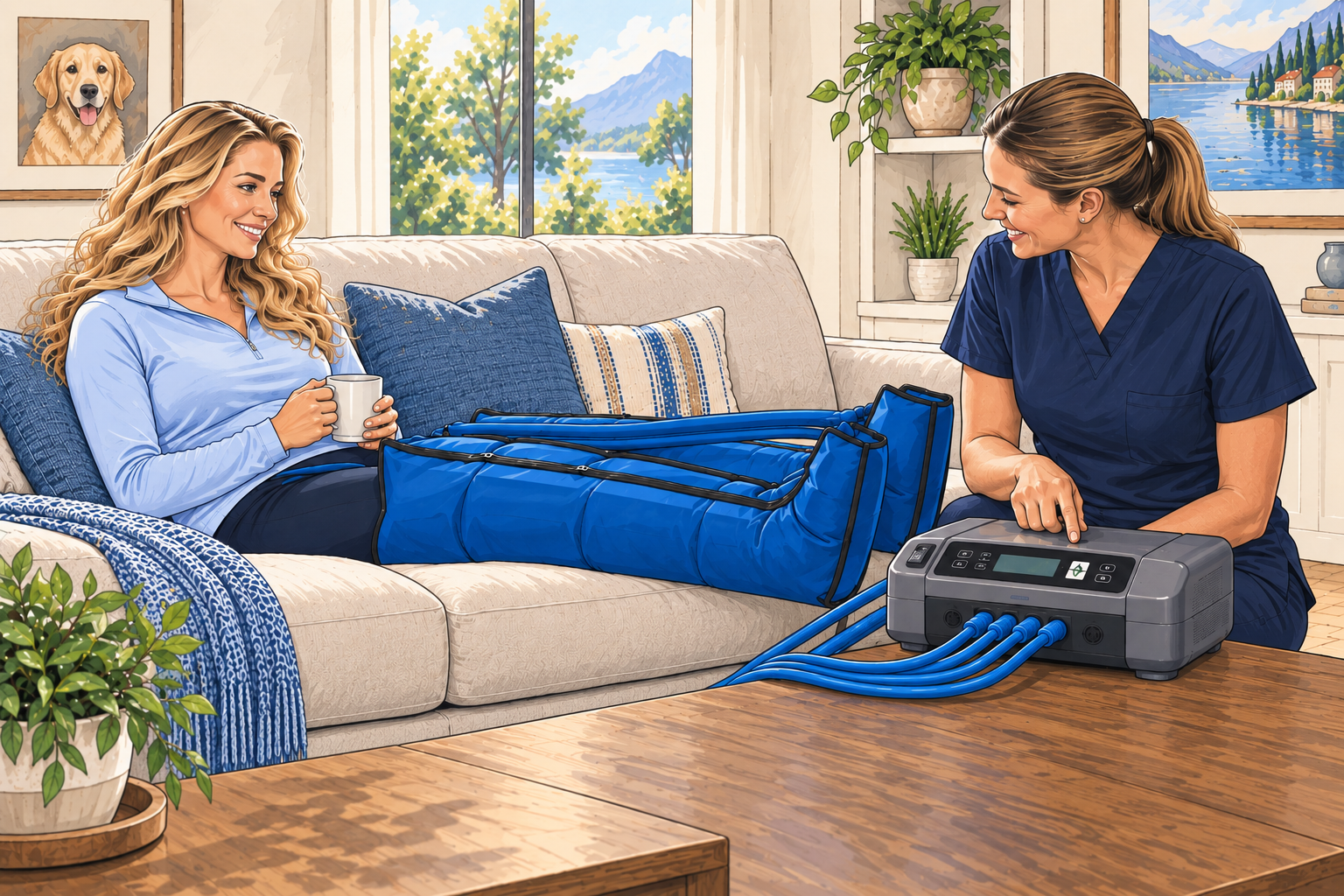
We set the patient up in person: how to apply the garment, how to operate the pump, how to follow the prescribed settings, and what to watch for between visits.
Support that does not end at delivery
A person to call when something is not working, and coordination with the physician's office for reassessment and continued oversight.
Two conditions, two separate coverage pathways
Lymphedema
Swelling caused by excess lymph fluid when the lymphatic system cannot clear fluid normally — primary, or secondary to lymph-node removal, radiation, surgery, trauma or scarring. Home pneumatic compression is considered when significant symptoms persist despite the required conservative pathway.
Chronic venous insufficiency with venous stasis ulcers
Medicare treats this as a separate pathway, with its own conservative-therapy requirement directed by the treating physician. Chronic venous edema on its own is not the same as meeting these criteria.
Important
Swelling alone does not establish coverage. The treating practitioner determines whether pneumatic compression therapy is medically appropriate and documents the patient's actual condition; the payer's criteria determine coverage.
Easy for the office. Clear for the patient.
Physicians should not have to become DME coordinators, and patients should not have to chase paperwork. Waypoint takes on the process that sits around the clinical care.
A single referral contact
Demographics, insurance and the current clinical note open the case. We verify the patient's pathway from there and never ask an office to figure out Medicare's requirements on its own.
A specific next step
When something is missing, your office gets the exact element and who needs to complete it — not a vague request for more documentation.
A status on every case
Every referral has an owner, a next action and a date. Your team should never have to call and ask what happened to a patient.
Send the referral. We handle the rest.
Send what you have. We'll review the case and tell your office what is still needed.